


You know the cartoon where the coyote runs straight off the cliff & keeps going, legs spinning, perfectly fine, right up until he looks down?
Medicare’s income surcharge works a lot like that edge. Except the, “looking down,” part happens when the bill shows up.
Start with the baseline. Medicare Part B (the part that covers doctor visits & outpatient care) costs $202.90 a month in 2026. That’s up $17.90 from 2025, an increase of just under 10 percent. Nobody got a 10 percent raise this year to cover it.
For higher earners it gets worse. A surcharge called IRMAA, short for Income-Related Monthly Adjustment Amount (a mouthful that means, “you made too much money”), gets stacked on top of the standard premium.
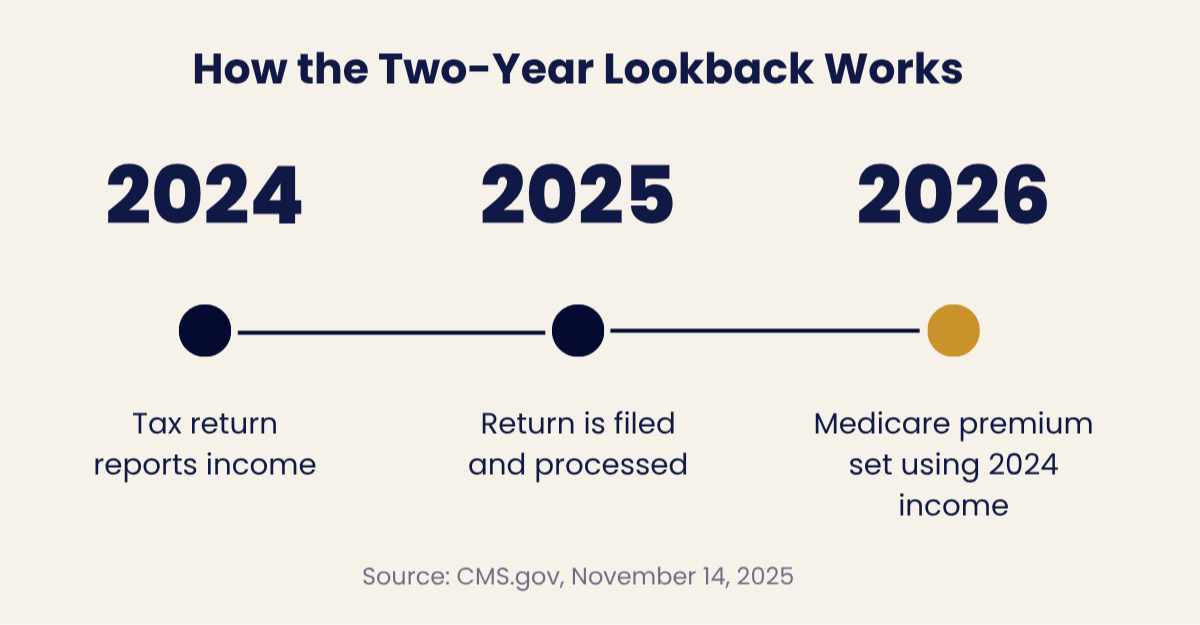
The two-year lookback
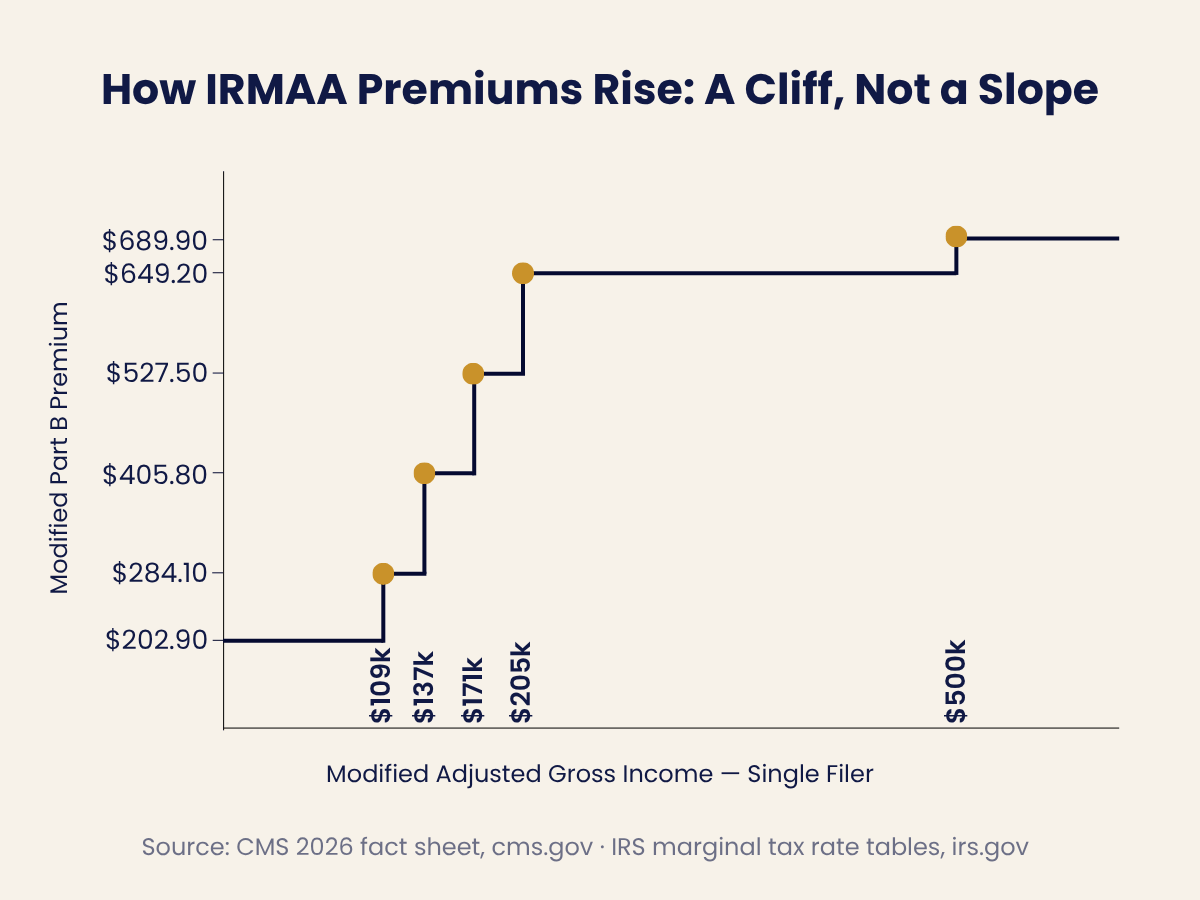
Here’s the part that surprises folks. IRMAA isn’t based on this year’s income. It’s based on your tax return from two years ago. Your 2026 premium comes from your 2024 return, specifically your MAGI, or modified adjusted gross income. That’s roughly the bottom-line income number on your tax return with a few items added back. If the 2024 return isn’t available yet, Social Security falls back to 2023.
The rule has been around since 2007, so it’s not new. It’s just new to you if you’re a new retiree, and you meet it for the first time while enrolling in Medicare. The result is a growing number of people paying a surcharge based on a salary they no longer collect.
It’s also not a small club. CMS estimates about 8 percent of people with Part B, and a similar share of those with Part D drug coverage, pay one of these surcharges. And it doesn’t take much to join. A pension plus an RMD (required minimum distribution, the amount the IRS makes you pull out of retirement accounts every year once you reach a certain age) is often enough to push a household’s MAGI past $109,000.
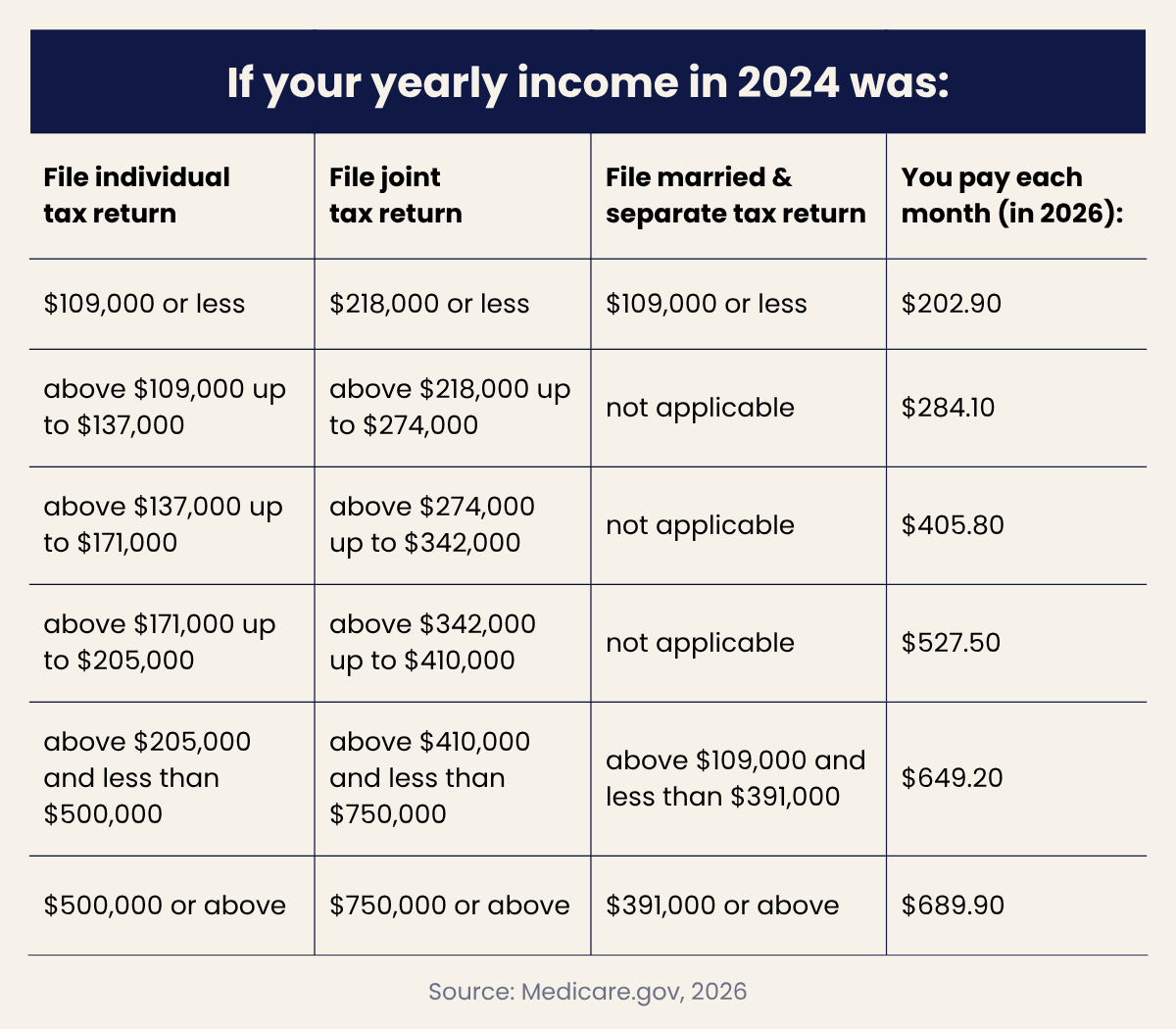
A cliff, not a slope
Income tax brackets are marginal. Cross into a higher bracket and only the dollars above the line get taxed at the higher rate. IRMAA doesn’t play that way.
Every tier is a cliff. Report $109,001 instead of $109,000 as a single filer, and the surcharge for that entire tier applies for the full year, for both Part B and Part D. That one dollar costs about $1,148. For a married couple filing jointly, the same tax return sets both of their premiums, so that one extra dollar adds roughly $2,297 to the combined bill.
(The top thresholds, $500,000 single & $750,000 joint, were set by the Bipartisan Budget Act of 2018. The lower tiers inch up each year with the cost of living, but the top ones are expected to stay frozen until 2028.)
But what if your income already dropped?
The lookback assumes life stays fairly steady. For plenty of people approaching Medicare, it doesn’t. Retirement itself is the big one, and it often lands in the same window as Medicare enrollment.
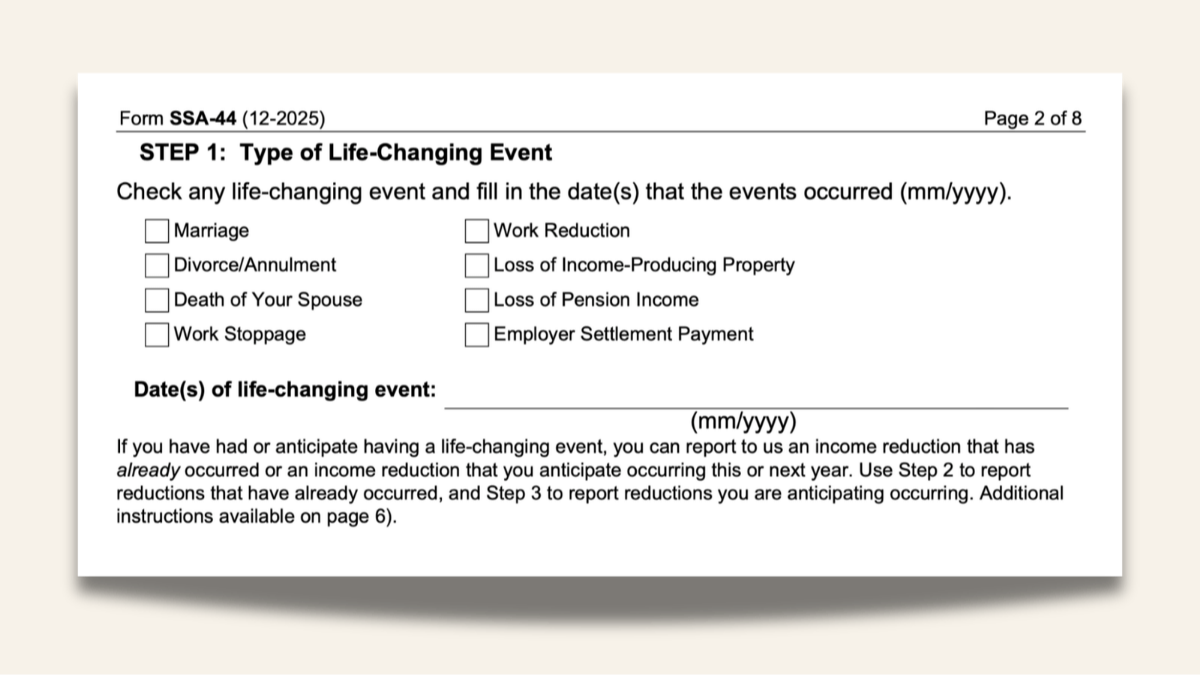
Social Security built a form for exactly this mismatch: Form SSA-44, Medicare Income-Related Monthly Adjustment Amount, Life-Changing Event. (Yes, that’s the actual name. Nobody ever accused a federal agency of writing a snappy title.) It lets you ask Social Security to base this year’s IRMAA on a more recent income figure instead of the two-year-old return.
There’s a catch, and you knew there was one coming. The drop has to come from one of eight recognized events: marriage; divorce or annulment; death of a spouse; work stoppage (which includes retirement); work reduction; loss of income-producing property, like a rental home, to something uncontrollable such as a natural disaster; loss of pension income; or an employer settlement payment tied to a bankruptcy or reorganization. A general decline in income without one of those triggers doesn’t qualify.
How it works
Social Security typically mails the initial IRMAA notice in late fall. It lists the income figure they used & tells you how to ask for a new determination. From that notice you have 60 days to request a reconsideration, but a life-changing event can be reported any time during the year with the SSA-44.
Expect it to take a while. Social Security says typically six to eight weeks, and your premium stays at the higher amount until they decide. If they approve, the difference is refunded or credited going forward. You can mail the form, fax it, or drop it off at a local field office.
Why so few people file
Two reasons, I’d guess. One is structural. Part B premiums, IRMAA included, usually come straight out of your Social Security check before it hits your bank account. You never see the money leave, so the cost is nearly invisible.
The other is human. When a number comes from a federal agency, we tend to treat it as carved in stone, even when the agency itself built a formal process for changing it. An invisible cost plus a number that looks permanent is a good recipe for leaving thousands of dollars on the table.
Where I come in
When I help folks prepare for retirement income, I project the household’s MAGI to see what the income picture will look like, because small timing decisions can make a big difference. If an SSA-44 might apply, I’ll help you work out whether you’re eligible, gather the documentation, & coordinate with your tax professional.
This is general information, not tax or legal advice, so please run your specific situation past your tax, legal, or accounting professional before filing anything.
And if you’d like to simplify & organize your retirement income, reach out to me.
Sources: CMS.gov (Nov. 14, 2025); SSA.gov (2026); Medicare.gov (2026); TheFinanceBuff.com (Aug. 22, 2026); AARP.org (Dec. 27, 2025).