


This is a version of a note I sent to my clients ahead of Tuesday’s midterm elections. I think it’s useful for anyone living through a 24-hour news cycle, social media and a phone that never stops buzzing, so I’m sharing it here.
When you were a kid, you probably heard a parent say “cover your ears.” Sometimes it meant I don’t want you to hear this. But sometimes it meant something loud is coming, and this will protect you. Fireworks, a train going by, a siren.
I’m telling you to cover your ears, and it’s the second kind.
There’s going to be a lot of noise between now and the holidays. The midterm elections are Tuesday, and the results will be spun in every direction for weeks. The war with Iran could expand, and every escalation will get its own breaking-news banner. Add social media, push alerts and a stream of confident predictions, and you get a constant flow of information that is mostly designed to hold your attention, not to help you make a good decision about your money.
The midterms
Wall Street has a well-worn pattern around midterm elections, and it has little to do with who wins. According to U.S. Bank research, the S&P 500 (the index of 500 large U.S. companies) has averaged about 2.9% in the 12 months before a midterm, versus about 12.4% in the 12 months after. The Motley Fool, using data back to 1874, found stocks rose in the year after 32 of 38 midterms, and by 14% on average.
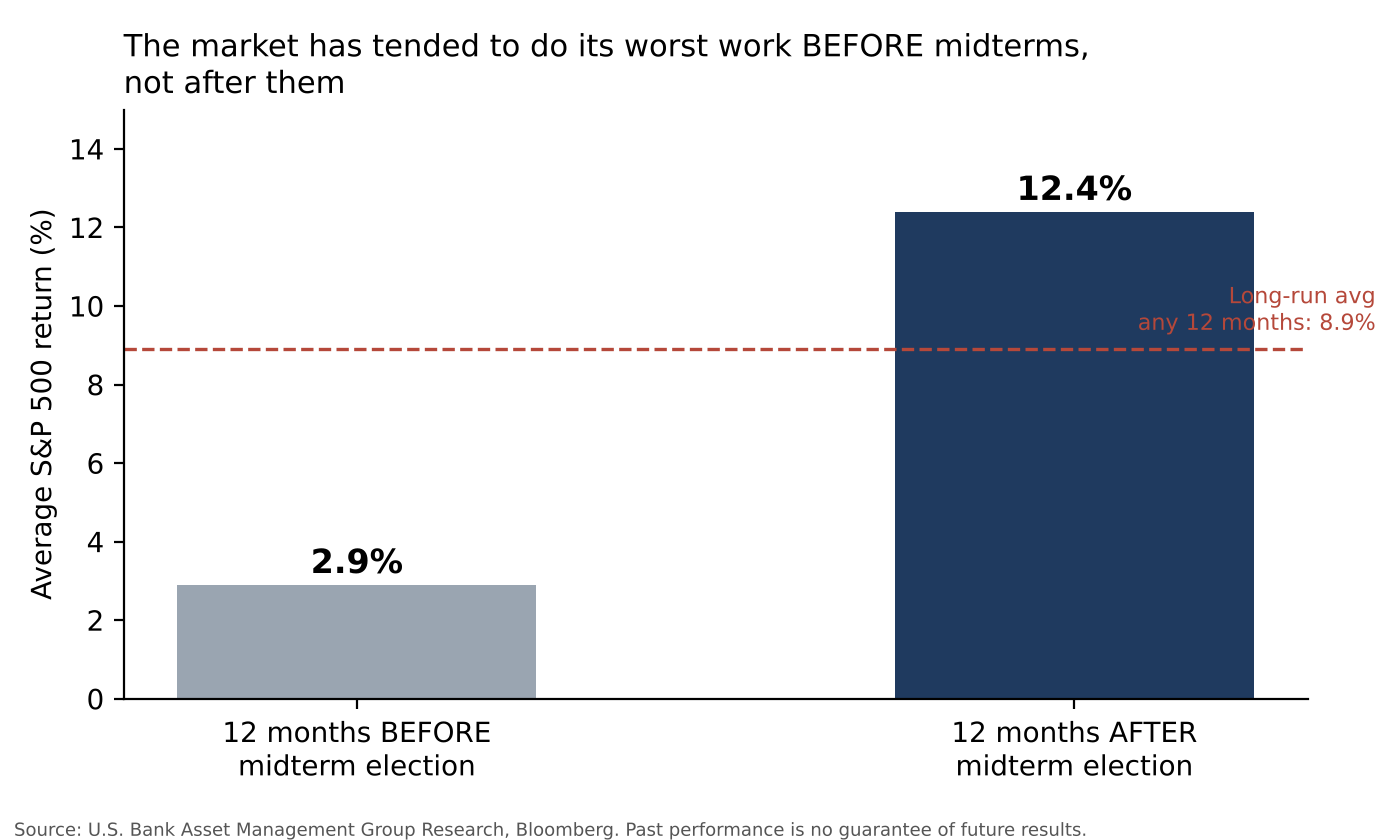
That happened under unified government, divided government, Republican presidents and Democratic presidents. The likely explanation is boring: once the uncertainty is resolved, the market moves on to what drives it over time, which is corporate earnings and the economy.
Researchers have tried to find out whether the party in power, or which chamber of Congress it controls, can be used to predict returns. Their answers disagree. Some find unified government is better, some find a split Congress is better, and some find the party of the president matters most. The samples are small (a few dozen elections), and the researchers themselves warn about data-mining, which means searching until you find a pattern that’s really just noise. If the experts can’t agree on the effect, I certainly can’t trade on it, and neither can anyone else.
Iran
I take the war seriously, and I’m not dismissing it. But here is what I can’t do: predict what happens next, and neither can anyone else. That includes the strategists on TV.
Here is what history does show. Across more than 40 major shocks since World War II (wars, terror attacks, financial crises), LPL Research found the market typically fell about 1% on the first day and recovered within a couple of months. What mattered most afterward wasn’t the headline, it was whether the economy fell into recession.
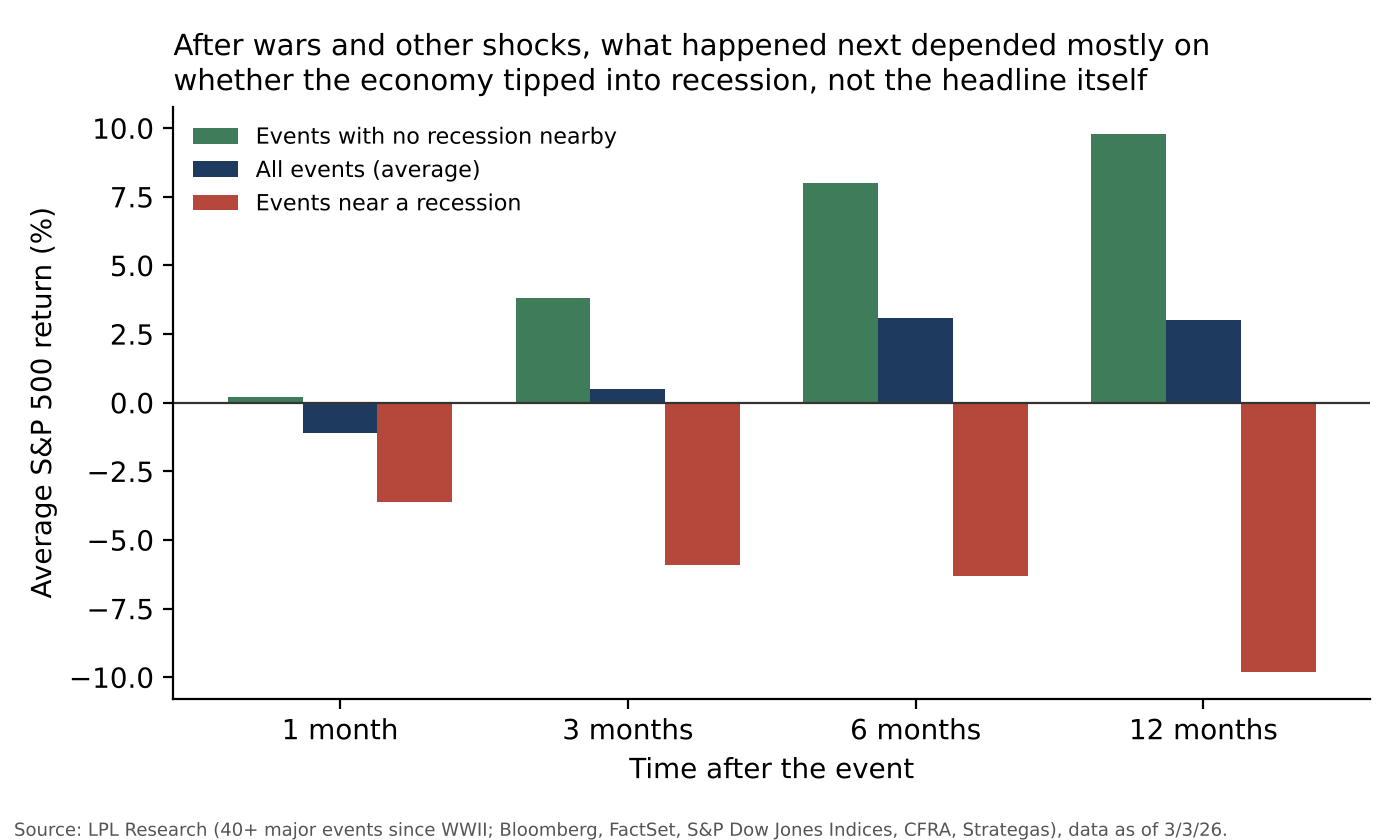
This year has already given a preview. Stocks fell roughly 10% early in the war and then recovered. The people who sold during the drop missed the recovery.
A risk is oil prices. They’ve been elevated and recently moved higher, and that feeds inflation and slows growth. That’s a real thing to watch. But watching it and reacting to it are different, and selling stocks because of a headline has historically been the wrong response far more often than the right one.
What to do with all this
A good financial plan is built on your life: when you need money, how much you need, and how much risk is appropriate for your period of life. How your money is divided among stocks, bonds and cash (your asset allocation) follows from that. It should be built for both your short-term needs and your long-term goals, not for an election result or a war nobody can predict. This is the idea behind Asset Life Matching, a framework I’ve developed that borrows the matching principles used in institutional finance and applies them to your own life.
If that’s how your plan was built, an election or a headline isn’t a reason to change it. If it wasn’t, or you’re not sure, finding out might be a better use of your next hour than another news alert. And if the noise is making you uncomfortable about your own situation, that’s a signal to sit down with someone and talk it through sooner rather than later. A plan should make you feel more settled, not less.
Until then, cover your ears.
If you’d like to talk through your own situation, you can contact me at Verbatim Financial, or find a flat fee advisor at Flat Fee Advisors.
This post is general information, not personalized investment, tax or legal advice. Past performance is not a guarantee of future results. Sources: U.S. Bank Asset Management Group; The Motley Fool (Shiller data); LPL Research; CXO Advisory; Dimensional Fund Advisors.